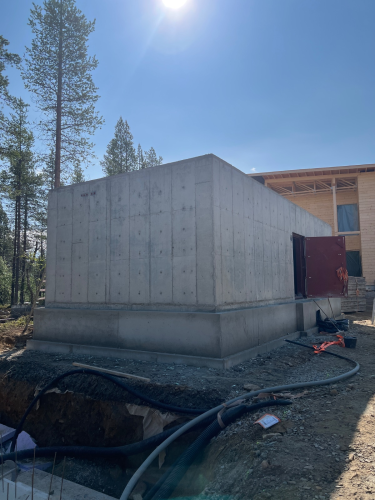

Anfra tarjoaa kaikki S1-luokan väestönsuojien rakentamiseen, suunnitteluun ja varustamiseen liittyvät palvelut. Sujuvan ja kustannustehokkaan projektin saa varmimmin ottamalla meidät mukaan jo suunnitteluvaiheessa. Väestönsuojien rakentaminen ja varustelu ovat tarkasti säänneltyä toimintaa, ja me olemme siinä alan huippuasiantuntijoita.
As experienced experts in civil defense shelter construction, we are capable of swift action. At our fastest, while closely accommodating the customer's wishes, a shelter can be cast in just five days from the start of the project.
We have been constructing cast-in-place civil defense shelters since 2015, and we currently build approximately 10% of all civil defense shelters in Finland. Furthermore, having delivered shelters across dozens of municipalities, we are highly familiar with local variations in how regulations are interpreted.
Our services also include equipping the shelter, measuring the tightness of the shelter and the inspection report.
We are happy to help our clients with the construction solutions and the bureaucracy involved in building shelters. Therefore, it is a cost-effective option for the builder to involve Anfra at the design stage.
Our crew is well-versed in building other heavy concrete bunkers as well. This exact same technique can be easily applied to construct, for example, watertight sprinkler reservoirs.
When building shelters, Anfra always recommends ordering a complete package from the same contractor, as this is usually the easiest and most cost-effective solution for the client.
Structural design and calculation of shelters with the quality and confidence of experience.
Foundations, floors, walls, vault and slab in situ.
Ventilation ducts and other penetrations, doors and hatches in public shelters.
The after-sales package includes the installation of the statutory crisis equipment and fittings, as well as a leakage measurement.
Constructing a civil defense shelter using Anfra's cast-in-place method offers numerous benefits. A single package provides cost-efficiency, optimized structural designs, the execution of all structures starting from the foundations, as well as cast-in components complete with their layout drawings. Furthermore, we fully equip the shelter ready for use.
In-situ casting simplifies the alignment and scheduling of different project phases, keeping the needs of the construction site in focus. The outer walls, vault, and collapse slab are concreted in one go, which guarantees a seamless and highly impermeable build. To top it off, our site manager takes care of all material procurement and work organization.
Design experience of more than 100 S1 class civil protection systems. We provide cost-effective design that saves both the client and the environment.
Once the formwork is fully completed and reinforced, concreting begins. Concreting is carried out at the same time for the outer walls, vault and slump floor. This working method has been proven to work irrespective of the season, with hundreds of shelters in operation.
The water-tightness of the structures is ensured, as there are no soldered joints (in some sites, prefabricated structures are even prohibited to ensure water-tightness).
We can deliver a cast-in-place civil defense shelter in as little as 4 working days, with a standard completion time of about 1 to 3 weeks.
If needed, we can also construct all other concrete structures for the project, complete with structural designs.
In precast civil defense shelters, constructing the foundations and the floor slab is more demanding due to the element-based technology, so these phases usually fall under the client's responsibility. When running a cost comparison, one must be careful to accurately account for the site costs associated with a precast shelter. We would be glad to assist you in making this comparison.
Väestönsuojien rakentamista säännellään laeilla ja asetuksilla, mutta paikallistasolla rakentamista ja suunnittelua ohjaavat ja valvovat alueelliset pelastuslaitokset ja kunnalliset rakennusvalvontaviranomaiset. Rakentamisessa on tärkeää kääntyä aina ensisijaisesti paikallisten viranomaisten puoleen. (SPEK, 2016)
(Rescue Act 379/2011, SPEK, 2016)
- The obligation to build a public shelter arises when the floor area of a group of buildings for living, working or staying is at least 1200 m2. For industrial, production, storage and assembly buildings, the obligation to build a civil protection system arises when the floor area is at least 1500 m2. The Rescue Act lists exceptions to the above limits.
- The actual protection space of a public shelter must always be at least 20 m2. However, the shelter itself does not include the barrier room or tent, or the technical rooms (engine rooms and control room), for which additional space must always be provided. In practice, the smallest shelter that can be built is 24 m2 (protected area 20 m2 , flysheet 2,5 m2 and 1 IV installation 1,5 m2)
- The wall and vault shall be at least 300 mm of strong reinforced concrete. The shelter floors shall have a minimum structural thickness of 150 mm. The room height shall be at least 2300 mm.
- A water point is not mandatory inside the shelter, but it must be located in the immediate vicinity of the shelter (some exceptions exist).
- The most cost-effective structural solutions can be achieved by using the theory of yield stress in strength calculations.
The shelter may be in peacetime use, but must be able to be taken into shelter use within 72 hours. In order to ensure the functionality of the shelter equipment, shelters must be inspected and maintained every 10 years (Decree 506/2011).
In schools, kindergartens and service homes, shelters are often used as social, laundry and storage facilities, sometimes even as teaching facilities. In hotel and sports facility projects, shelters are often used as gyms, changing rooms or equipment storage. In residential projects, by far the most common peacetime use is for apartment-specific cage storage. Civilian shelters that are not used at all in peacetime are already rare. In everyday language, many people refer to these facilities as bomb shelters.
Finland has been preparing for systematic protection of people and property in crisis situations since 1958. Preparedness has been made by building modern civil defence shelters and functional shelters during normal circumstances. (PESK, 2016)
The shelters built today provide protection against radiation, toxic substances, collapses and the effects of weapons. Biological and chemical warfare agents are also well filtered by the filter material of modern filters. (Population Protection, HelsinkiTurva 2019)
Sources
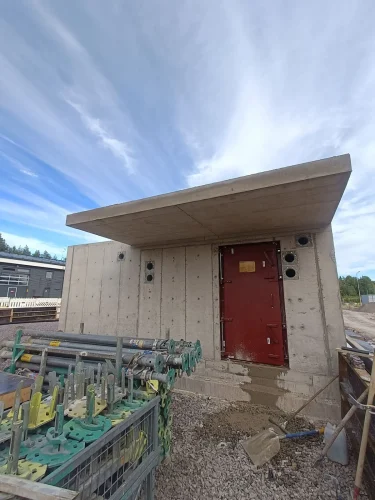
On-site cast civil shelter for the new Talliosake building in Sundsberg, Kirkkonummi.

Sales Manager
Civil defence shelters
Small sites